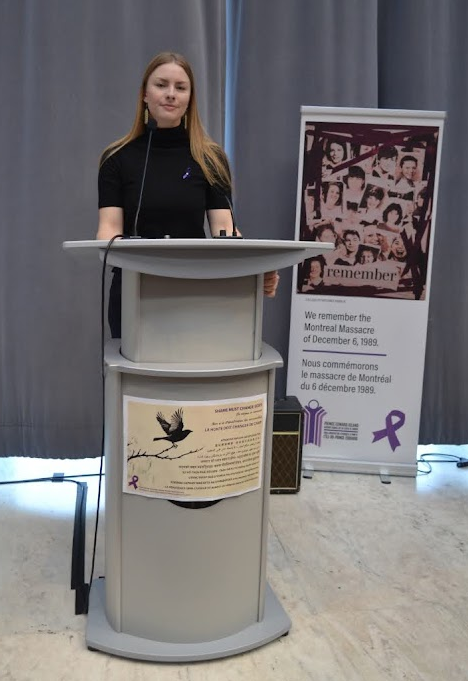
Alyssa Coghlin, Therapist at the PEI Rape and Sexual Assault Centre, was the guest speaker at the December 5, 2025 Montreal Massacre Memorial Service.
It’s an honour to be here with you all today for this memorial. There is power in the returning and remembrance and advocacy – each and every year. Thank you to the PEI Advisory Council on the Status of Women for inviting me to speak today. I also want to acknowledge everyone in this room— Elders, survivors, supporters, families and friends of loved ones lost, and community members. As well as those who haven chosen to stay home and are hopefully warm. I’m glad you’re taking care.
I am only one voice, and I acknowledge the many diverse stories and voices in this room, and honour that we will each carry our own histories, perspectives, and relationships to survivorship, to trauma and to healing. And I also believe we all know in some form what it means to carry the weighted silence of shame.
Survivors of sexual and gender-based violence: you unjustly carry the weight of shame, and it does not belong to you. Families and friends of loved ones lost: your grief is also a collective and community loss. This never should have happened, and nothing justifies this violence.
Nervous system acknowledgment:
I want to start by naming that this room is holding a lot right now. This is a heavy day. For myself, I’ve noticed my feelings of vigilance, fear, anger, sadness, grief, vulnerability… as well as honour, gratitude and connection.
Invitation: Notice what’s here with you now, in your body, in this space. Maybe a breath. You may feel different nervous system responses:
- Ie. Fight responses – anger, motivation, desire for justice
- Flight – need to get away
- Freeze – disconnect, feel numb
- Or even shame that might still be present. Sometimes even saying
the word shame brings up shame. - You might be deeply exhausted.
- All of these make a lot of sense. And they are protective when needed.
Even if just by noticing how we are here, right now. By not judging what emotions or responses we show up with.. And rather name that we have shown up – we are facing one small and important piece of letting go of shame.
We are witnessing so much in our complicated world right now, so no wonder it is hard to hold this pain and grief, we cannot carry it all alone. How meaningful it is, that the person sitting next to you, whether you know them or not, also chose to be here, and has their own story. And that
the weight of today is shared. This represents a community that cares. You are not alone.
I also want to offer another invitation: which is to check out if you need. There are no expectations for your feelings. It’s understandably hard to be fully present here. So connect with what you can or would like to. You do not need to push past your body’s communication when it is saying no.
Some Roots of Shame:
I do now want to speak a bit more about the roots and stories of shame, and what is beyond our experience of it.
Shame is often used by systems as a tool of power and control. And sexual and gender-based violence cannot be separated these systems of patriarchy, misogyny, colonialism, racism, transphobia, homophobia, ableism (to name just some) which unjustly deem certain lives as less worthy of protection.
So I want to make clear that accountability is the responsibility of systemic change, of governments, institutions and individuals that perpetuate this violence and shame… And for today I am focusing on one piece of this healing, at that is the lifting of shame from survivors.
- I understand that acts of violence and violation inherently created trauma in systems, both individual and collective. And shame too, is a response to trauma.
- You are not responsible for how someone treated you, or for the violence they caused.
- When those who caused harm don’t take responsibility for their actions, this shame often falls on survivors. I want to name again: survivors: it is not your shame to hold, and means nothing about who they are.
- When we are not able to protect ourselves, or those responsible do not take accountability, sometimes the most protective thing we feel we can do is
believe we could have. - Shame is sometimes a response to not being able to meet our own expectations and needs for safety and protection. I believe this is a normal response to a system and society that has not been able to keep us all safe.
- Shame silences, keeps us small, and often creates a fog, preventing us from being able to live in an embodied reality and to be more fully
present with ourselves and others.- Shame can look like: closing in, disconnecting, feeling alone, feeling silenced, or like it’s not safe to be seen.
- It might also look like having spoken up, and others silencing you, out of their own fear.
- Shame says: something is wrong with you, you shouldn’t be feeling or experiencing what you are.
- It’s a complex emotion and experience that makes us feel vulnerable. It’s painful.
- And, it does not define us.
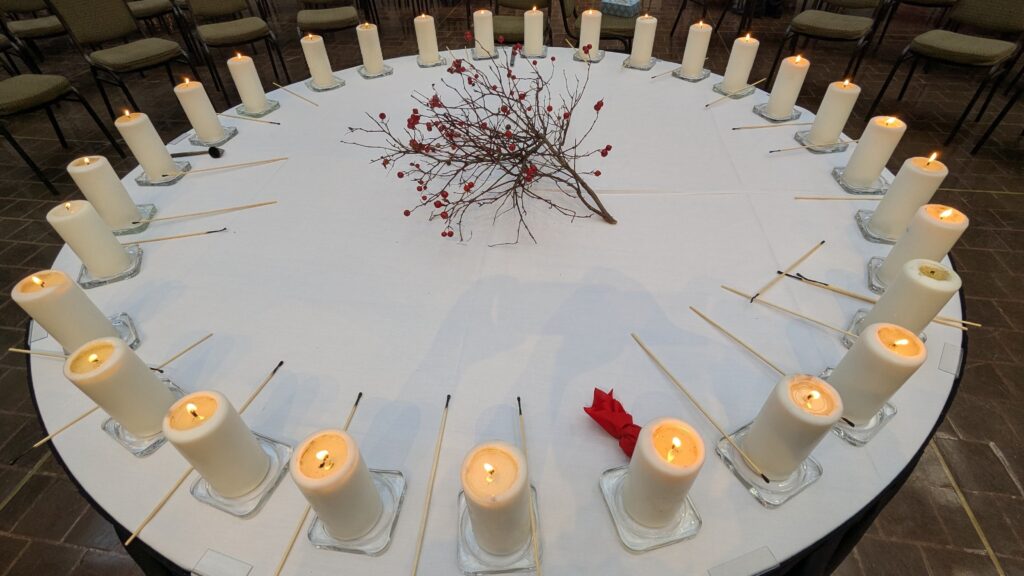
Shame, like a candle, takes time to melt away. And bringing light to feelings of shame, helps us to do so.
I wish it were easy to say: “It’s not your fault what happened to you”, and to have this be believed right away. Of course, it’s never been as simple as this.
So, my hope is not to “shame the shame” in each other. Healing often moves slowly, and is non-linear. It’s not always safe or easy to speak out loudly, and there are reasons why we hold this fear. Survivors have agency of their story and their own process and pace of healing.
How truly powerful it is to hear survivors and activists like Gisele Pelicot, speak her name and story so publicly and lessen the shame and stigma on survivors! It gives others strength to know the shame does not belong to them either! And, all forms of courage, whatever their volume, are
still courageous.
When we see others holding themselves and each other with dignity, safety, and care, it reflects to us that we too are welcomed into the power of our own free bodies. We can begin to trust others reflections…seeing them notice the light in us.. and begin believing too that we are worthy of being seen and known in our light and power. When we truly listen to each other without judgement, and our systems follow through on accountability, increasing safety, we give the message that survivors and their stories are worthy of the fierceness of protection and the gentleness of care.
We cannot always move faster than the pace of trust. And no wonder it’s been so hard to trust when the violence has not ended.
For the community: The stories we tell about sexual and gender-based violence also perpetuates what society deems permissible. I hope we can keep telling them differently.
My hope is also that we can move from shaming systems and individuals to accountability. I don’t believe shaming changes anything on its own. I believe it keeps us all stuck. Yet, the rightful and sacred rage so many of us feel is vital, and validates that absolutely nothing justifies the violence and harm that has been caused. And that as survivors, you are not to blame for another’s actions. This is theirs to live with and transform.
In closing:
Survivors, and those affected by gender-based violence, have been working so hard to heal and survive every day, they deserve rest, safety, and thrivance. I also want to name the connection, joy and empowerment in the healing, that I have had the sincere privilege of being able to witness in my work and communities. I don’t want to forget this very important part.
What is beyond shame?: You are. We are.
The moments of presence are reminding yourself that you’re here, and you’re alive. Allow us to see possibility of a different future.
Joy, itself, is a vulnerability that is secure. Our connections and communities can help create the security for joy to be more possible.
When we witness ourselves and others finding the joy in their healing and changing, this changes us too.
I’d like to end with words from a dear friend of mine, survivor, writer and author, Finley de Witt. Finley has wished to share their voice and has given me permission to share this extract from a letter they wrote to their parents:
I understand the causes and conditions that drive perpetrators to do what they do, but do not mistake my compassion for weakness or compliance. My compassion closes the door in the face of your denial and gaslighting; my compassion says: ‘This ends here’. I will not force others to carry my pain as you forced me to carry yours. In the safety of this fierce compassion, I turn with an open heart towards my grief and despair and give them space to breathe and to heal.
Thank you.
by Alyssa Coghlin
Guest Speaker
December 5, 2025 Montreal Massacre Memorial Service