
International Women’s Day: Give to Gain
 Honourable guests, ladies and gentlemen,
It is March 8th, 2026. We have journeyed through the heavy snows and hard work of winter, and here we are, finally approaching the threshold of Spring.
Recently, I had the opportunity to travel back to my first home, Taiwan, and visit the neighboring islands of Okinawa. After living for 20 years in Prince Edward Island, looking at Asia through a Canadian lens offers a fascinating contrast. For International Women’s Day 2026, our global theme is “Give to Gain.” It is a prompt that asks us to think about how reciprocity, mentorship, and the shared surrender of power can actually multiply success for everyone.
Taiwan: The Visible Gain
In Taiwan, the “Give to Gain” spirit is literal. The society has “given” women a seat at the highest tables and “gained” one of the most resilient democracies in the world.
- Leading the Region: Taiwan remains #1 in Asia for gender equality. With over 40% of legislative seats held by women in 2026, it has surpassed many Western nations.
- The Dinner Table Negotiation: However, my observation from this visit is that while the “gain” is visible at the top of government, the “giving” is still being negotiated at the dinner table. In the private sphere, women still carry the invisible weight of traditional family expectations. In Taiwan, we have gained the office, but we are still working on giving women true balance at home.
Japan: The Quiet Synergy
In Japan, the landscape is shifting from a model of “sacrifice” to one of “synergy.” For decades, the “giving” was one-sided: women gave up their dreams to support the “salaryman” structure.
- Transparency as a Tool: As of April 2026, new laws require Japanese companies to disclose not just their gender pay gap, but the ratio of female managers. By “giving” transparency, Japan “gains” a competitive edge in a shrinking labour market.
- The Prime Minister’s Path: We see this most clearly in the re-election of Prime Minister Sanae Takaichi. She is proving that a woman leading a power change doesn’t always look like a liberal revolution. By “giving” a woman the helm, Japan has “gained” a path to modernization that the old guard simply wouldn’t have accepted from a man. Whether in Tokyo parks where fathers now push strollers, or in local Okinawan communities where women are increasingly active, Japan is learning that when men give more at home, the nation gains a future.
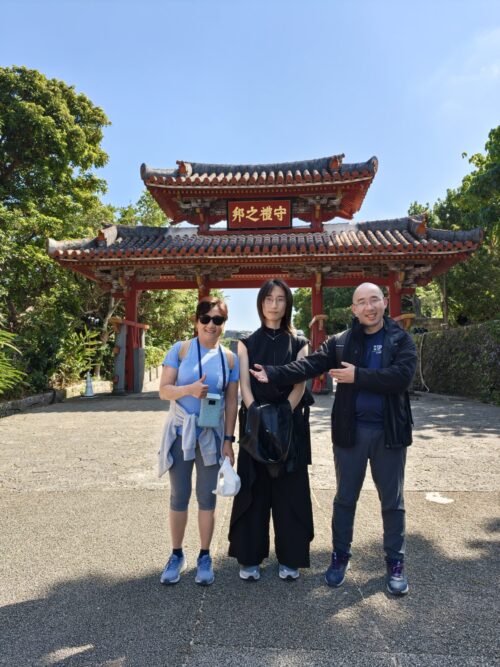
Hsiao-Yu with her family in Okinawa.
Canada: The Intersectional Lens
Bringing these reflections back to my life in Canada, the “Give to Gain” theme hits differently.
- Who is in the Room? While Taiwan and Japan focus on getting women into the room, Canada’s 2026 focus is on who is in that room. Through GBA Plus, we ensure that “gains” aren’t reserved for one demographic, but include Indigenous, Black, and 2SLGBTQI+ voices.
- The Economic Reality: We still grapple with a wage gap of roughly 87 cents. We know that if we “give” women equal pay, Canada “gains” a $150 billion boost to our national GDP.
The Global Takeaway
In my conversations across Asia, I realized that while Canada excels at the framework of equality, Taiwan excels at the representation, and Japan is currently mastering the mechanics of it.
The lesson of 2026 is clear: Equality is not a zero-sum game.
- In Taiwan, giving women power gained a global reputation for leadership.
- In Japan, giving women career paths is the only way to gain an economic future.
- In Canada, giving space to intersectional voices is the only way to gain true social cohesion.
As you leave here today, look for the small “gives”—the way a young man gives up his seat for a mother in Taipei, or how a mentor in Charlottetown opens a door for a newcomer. These are the ripples that create the “gain.”
Happy International Women’s Day.
Hsiao-Yu Liu.
A Commentary by Hsiao-Yu Liu, Chairperson of the PEI Advisory Council on the Status of Women. She lives in Charlottetown.